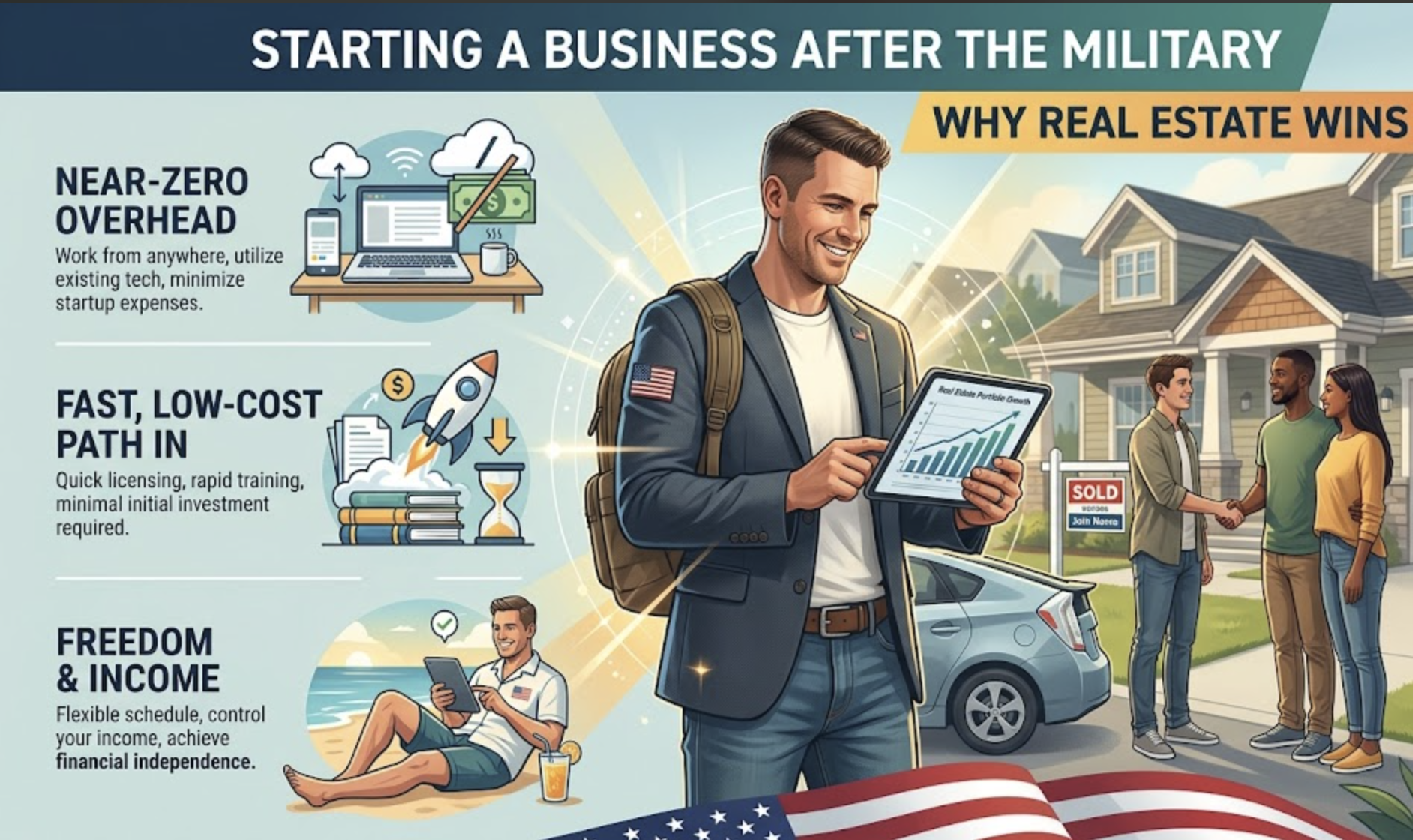
Near-zero overhead. A fast, low-cost path in. And the freedom and income to live life on your terms. Here is why a real estate career is the smartest first business for a veteran.
More than 1 in 4 service members want to own a business after they take off the uniform. Far fewer ever do — and the number-one reason starting a business after the military stalls is the cost and risk of a traditional startup. Real estate removes both.
If you are thinking about starting a business after the military, you are in good company. According to the U.S. Small Business Administration, more than 25% of transitioning service members say they want to start a business. The drive is there — the discipline, the leadership, the comfort with risk and pressure that the military builds into you. Yet only about 4.5% of post-9/11 veterans actually open one, compared to nearly 50% of the World War II generation.
That gap is not about ability. It is about the wall most veterans hit when they price out a traditional business: the lease, the inventory, the equipment, the payroll, the years of losses before profit. For most people leaving service with a family to support, that wall is simply too high. This is exactly why a real estate career deserves a serious look as your first business after the military — it gives you everything entrepreneurship promises without the brutal upfront cost.
The data is clear: when veterans do start businesses, they tend to outperform. Research from the D’Aniello Institute for Veterans and Military Families at Syracuse University found that 55 to 57% of veteran-owned businesses survive at least five years — higher than the national average — and that 98% of veteran entrepreneurs say the skills they developed in the military helped them overcome business obstacles.
Why do veterans do so well? Because the traits that make a great service member are the same traits that build a real business: discipline when no one is watching, the resilience to keep going through hard stretches, the ability to follow a system, and a comfort with risk that most civilians never develop. Those traits are worth more than any business degree — and they are exactly what a real estate career rewards. If you are seriously considering starting a business after the military, those service-built traits are your single biggest advantage.
When people research how to begin starting a business after the military, they usually look at the classics: a franchise, a restaurant, a contracting company, a retail shop, an e-commerce brand. Every one of them shares the same fatal flaw for someone just out of the military — they cost a fortune to start and take years to turn a profit.
Consider the realistic startup costs:
Every one of those paths asks you to bet your transition savings — and often your VA loan equity or a small-business loan — on the hope that revenue eventually exceeds a mountain of fixed costs. For a veteran with a family, that is a heavy bet. There is a better way in.
A real estate career is one of the only true businesses you can start for a few hundred dollars, run from your phone and laptop, and scale to a six-figure income without ever taking on debt, signing a lease, or hiring staff. When you weigh starting a business after the military against the traditional options, the math is not close.
This is the heart of why starting a business after the military works so well in real estate. A real estate career has almost none of the fixed costs that sink most new businesses. There is no storefront to lease, no inventory to buy, no equipment to finance, no employees to make payroll for. Your real overhead is a license, a phone, a laptop, and a modest monthly set of tools. You keep what you earn instead of feeding a machine that eats your revenue before you ever see it.
Getting licensed in Texas takes 180 hours of coursework that you can finish online in as little as five weeks, for a few hundred dollars. Compare that to the years of capital, permits, and buildout a traditional business demands. You can go from deciding to start to legally doing business in about a month — while keeping your current income until you are ready.
Here is the part that matters most when you weigh starting a business after the military. Because your invested money and time are so low, your return on both is dramatically higher. A single transaction can return many times what you spent to get licensed. There is no income ceiling set by a storefront’s foot traffic — your earnings scale with your effort and skill. That is what affords you the life you actually want: the freedom to set your own schedule, the income to provide for your family, and a business you own outright rather than one that owns you.
Most people who leave the military are not chasing a job. They are chasing autonomy — the freedom to control their own time, answer to themselves, and build something that belongs to them. This is the real reason starting a business after the military appeals to so many veterans in the first place. A traditional business promises that autonomy and then chains you to a storefront and a payroll. A real estate career delivers it.
You decide your hours. You decide your market. You decide how big you want to build. You can run it solo with near-zero overhead, or grow it into a team. You can serve the military community you came from, helping fellow service members and their families buy and sell homes near posts like Fort Hood — work that means something. That combination of freedom, income, and purpose is exactly what entrepreneurship is supposed to deliver, and almost no other first business offers it at this low a cost of entry.
At Homevets Realty, our entire brokerage was built by a veteran for this exact path. We know what it takes to go from service to a thriving real estate business, because we have done it — and we help veterans and military spouses do the same through Join Our Veterans.
If you are ready to get serious about starting a business after the military, here is the simplest path from where you are now to a launched, income-producing real estate business.
Starting a business after the military does not have to mean betting your savings on a high-cost, high-risk venture. A real estate career gives you the ownership, freedom, and income ceiling of entrepreneurship — with a fraction of the cost, the risk, and the time. For a disciplined veteran, it may be the single smartest first business you can start.
Tell us a little about yourself and we will reach out with the next steps — no pressure, no obligation. Whether you are still on active duty, transitioning, or already out, we will help you map the path from here.
Your information stays private. We use it only to follow up with you personally and never sell or share your data.
Before you invest a dollar, take our free career readiness assessment. It scores you across the 7 traits that predict success in this business — the same discipline and grit the military already built in you.
Take the Free Assessment →